Realtime Nodes (WebSocket, Socket.IO, MQTT)
Connect, Send, and Receive nodes for all three realtime protocols.
Three protocols , WebSocket, Socket.IO, and MQTT , each with the same three roles: Connect, Send, and Receive. The fields differ per protocol, but the shape and how they chain together is identical across all nine.
Connect
Opens a persistent connection for other nodes to use. Output: a connection port that Send/Receive
nodes plug into.
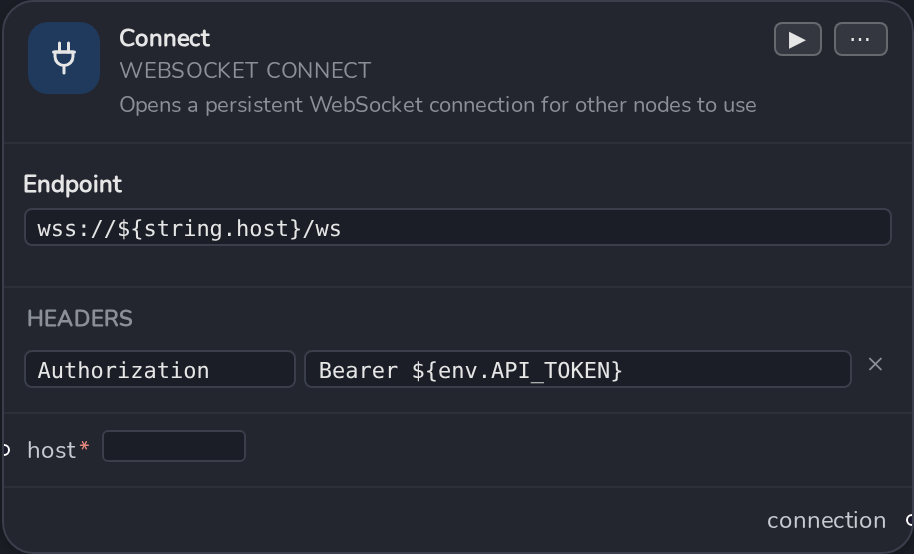
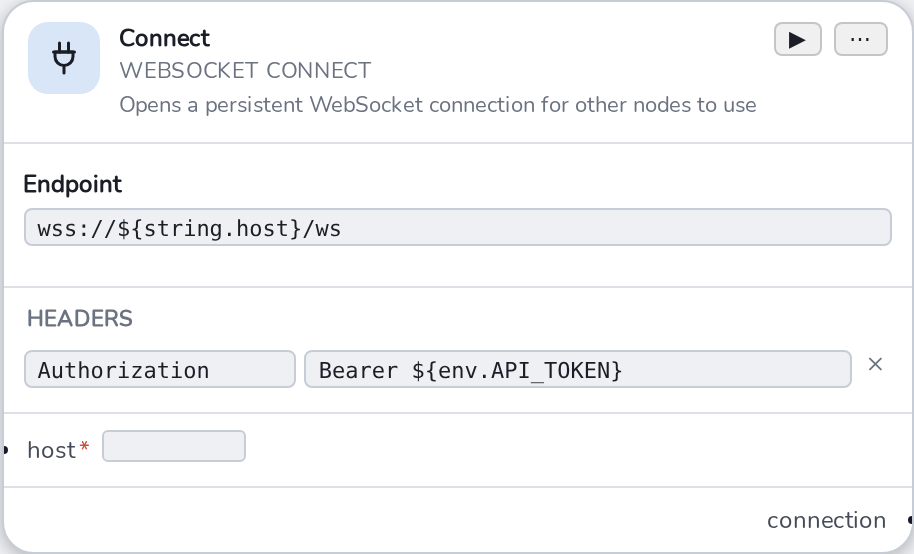
| Protocol | Fields |
|---|---|
| WebSocket | Endpoint |
| Socket.IO | Endpoint, Namespace (default /), Path (default /socket.io/), Auth (JSON) |
| MQTT | Broker, Client ID, Username, Password, Subscribe topics (comma-separated) |
Headers are available for WebSocket and Socket.IO connections (added via the ⋯ menu → Add Header) , MQTT has no header concept, so that option doesn’t appear on an MQTT Connect node.
Send
Sends a message over an existing connection.
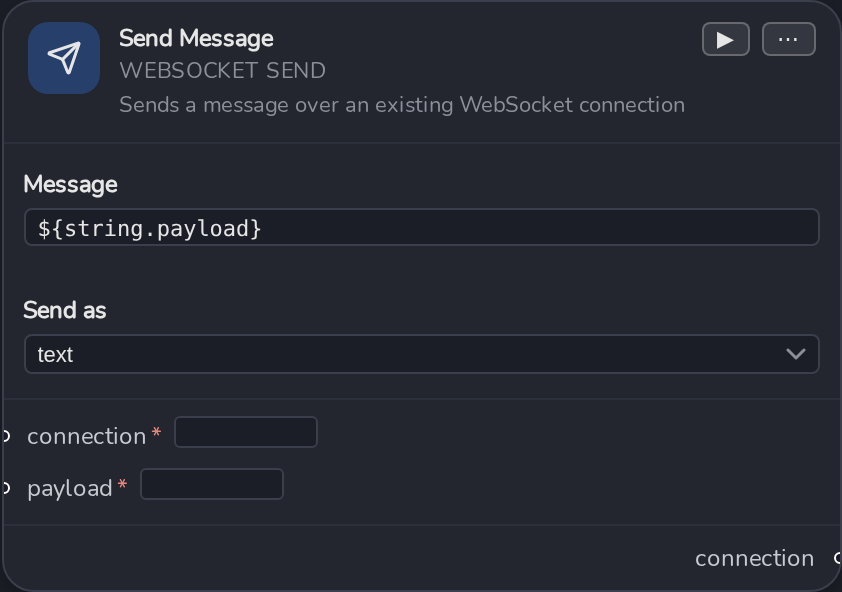
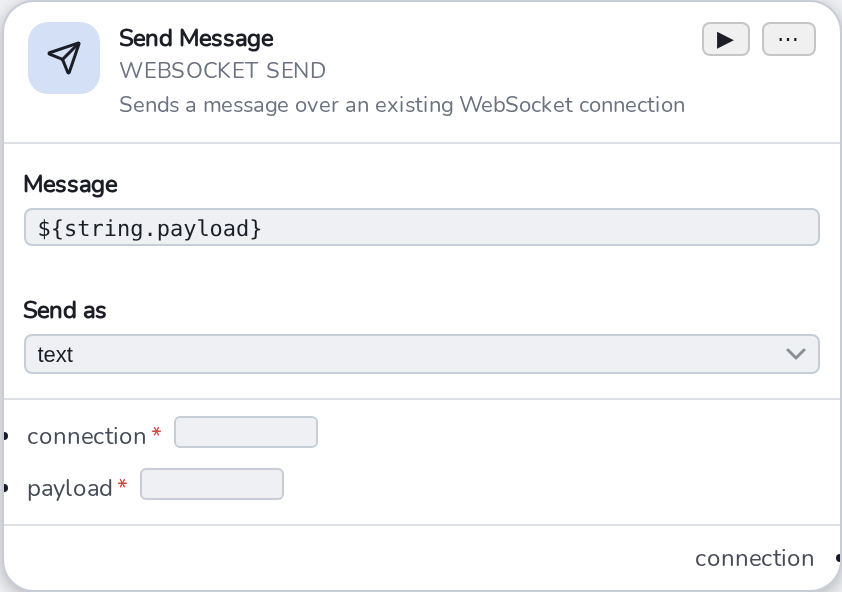
| Protocol | Fields |
|---|---|
| WebSocket | Message, “Send as” (text | binary) |
| Socket.IO | Event, Namespace, Message (JSON) |
| MQTT | Topic, Message, QoS (0|1|2), Retained (false|true) |
Every Send node has a required connection input port. That port’s id is deliberately the same one Connect outputs and Receive also exposes, so Send/Receive nodes can be chained one after another off a single Connect without renaming anything.
Receive
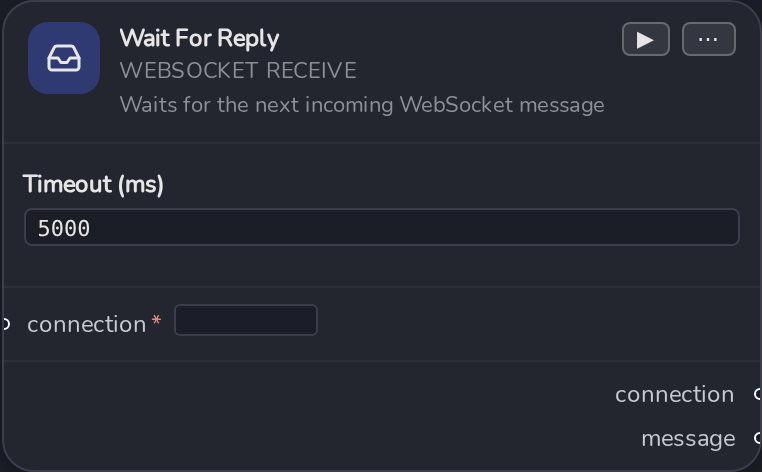
Waits for the next incoming message on a connection.
| Protocol | Fields |
|---|---|
| WebSocket | Timeout (ms) |
| Socket.IO | Event, Namespace, Timeout (ms) |
| MQTT | Topic, QoS, Timeout (ms) |
Receive has a required connection input, and two outputs: connection (pass it on to the
next node) and message (the received payload). message holds a steady pulse rather than a
one-shot flash, like the other envelope-style outputs , see Running Flows.
A typical realtime flow is Connect → Send → Receive, all wired through the same connection port
, connect once, then send/receive as many times as the flow needs, chaining each node’s
connection output into the next node’s connection input.